

5 TSA Security Tech Projects That Could Change Airport Screening
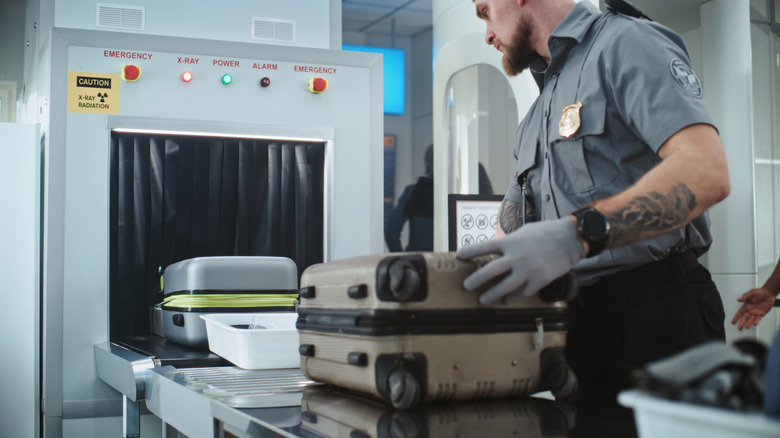
The difficulty with security technology, as advanced as it has become, is that the threats it faces are constantly evolving, too. As such, the priority for security organizations such as the Transportation Security Administration must always be to innovate, to introduce new measures, and to upgrade and replace old ones as necessary.
A primary role of the TSA, of course, is to screen passengers passing through airports. Frequent travelers know the drill: They pass through the airport body scanner, and their bags travel along the conveyor belt to meet them on the other side. This has been the standard since the TSA introduced the scanners broadly across the country in early 2010. Nevertheless, there are always ways to improve speed, efficiency, and convenience, particularly with a process that's as much of a bugbear for travelers as lengthy security lines.
The TSA is cooking up a range of tech projects that could help to alleviate some of the existing pressures of airport security, for both officers and travelers. They include Computed Tomography (CT) technology for more in-depth checking of baggage, Credential Authentication Technology (CAT) systems for faster and more effective verification of traveler identities, and ways of adding a further level of automation to existing procedures.
Here's a look at the different processes that the TSA is looking to employ, and how they'll make a difference to the future of air travel security. Some could revamp and potentially even automate aspects of the process, while others might fundamentally change the way that a specific role is performed. Not all of these projects are designed by the TSA itself, but all are potentially going to be introduced, or used more widely if already in limited service.
Automated lanes for security screening are rolling out across the United States
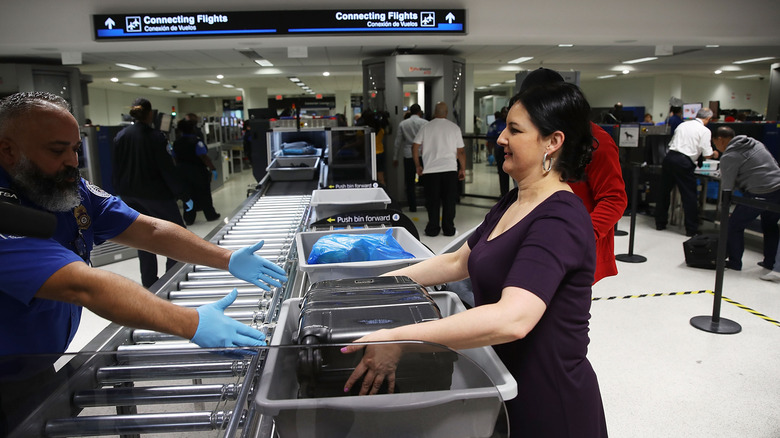
The security screening lanes in airports can become extremely busy during peak times. As a way to alleviate this, automated lines have been widely introduced at U.S. airports, beginning with some of the busiest, including those in New York, Los Angeles, and Newark. The lanes use a conveyor belt system, making it extremely convenient for users to place the appropriate belongings in the bins and then pass them along the conveyor.
In July 2024, a TSA press release announced that Baltimore-Washington International Thurgood Marshall Airport had received an upgrade in the form of these new lanes, which revolutionized the process in a variety of ways. The bins themselves have a considerably larger capacity, and the system can accommodate multiple at once to keep them moving smoothly. They are directed via a conveyor system to be X-rayed and then returned to the storage point at the front for the next group of passengers to access. If there are any issues with the contents of one of the bags during screening, it is rerouted separately from everybody else's for additional inspection.
It's a faster and more efficient system, and there have also been trials of a development beyond it, including self-screening. For example, in January 2024, Las Vegas's Harry Reid International Airport trialed a new PAX MX2 unit, developed by Vanderlande. Combined with advanced facial recognition, it allows users to screen their own belongings by following the instructions on the panels, before passing through a scanner themselves. A smaller, more mobile Computed Tomography unit was also trialed, allowing customers to X-ray their carry-on. Tested with TSA PreCheck passengers, there's potential for broader future adoption at airports.
Wearable Sensor for Contactless Physical Assessment
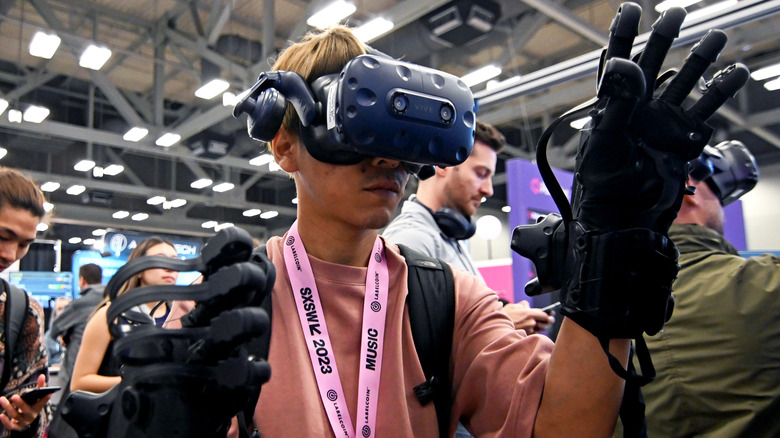
Virtual reality technology has some remarkable applications. In some ways, VR has changed the way we know gaming, and it may also revolutionize how TSA agents interact with travelers. One aspect of the security screening process that can be problematic is the pat-down screening. The TSA notes that those being screened can have a witness present and that the officer will explain each step of the procedure, but also warns that "since pat-down screening is conducted to determine whether prohibited items are concealed under clothing, sufficient pressure must be applied in order to ensure detection." An important step in helping make travel more comfortable and accessible, then, is to explore technologies such as the U.S. Department of Homeland Security's Wearable Sensor for Contactless Physical Assessment project.
The device is conceptual, as of the time of writing, with the TSA describing it as a device with a pad to provide haptic feedback, complete with cameras and sensors. It's like a much more elaborate version of a glove that allows the user to handle objects in a VR video game, such as the one pictured here. The organization reports that "the touchless sensor system could be enabled through millimeter wave scanning, light detection and ranging (LiDAR), or backscatter X-ray technology."
Using such technology, a TSA officer would still be able to feel the areas on a person's body where the checks have to be performed using haptic feedback. This could also mean that, should they discover an illicit and potentially dangerous item or substance, they would be able to examine it more closely without the need for physical touch.
The AI threat-detecting capabilities of newer computed tomography machines
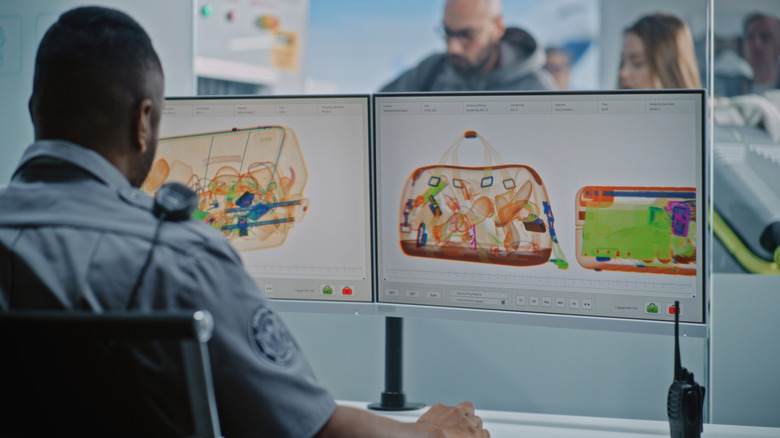
As with any topic exploring current and developing technology, there's really no getting away from the influence that AI is going to have in the field of airport screening. Sometimes, it's not about an innovative new tool, but about augmenting technology that's already in use in order to make it even more effective.
Computed tomography machines represent the next step in carry-on scanning technology. TSA has been putting them in U.S. airports for some years, announcing in 2018 that 15 of the machines would be placed in airports like John F. Kennedy International Airport and Washington-Dulles International Airport by the end of that year. What's so important about these machines is the way that they level up the screening process.
The TSA notes that existing systems without CT provide officers with a 2D view of the contents of the bag in question, while CT models can use "sophisticated algorithms for the detection of explosives and other threats by creating a 3D image that can be viewed and rotated 360 degrees for a thorough analysis." This system, of course, does not remove the need for a manual search, whether routine or as a result of a potential issue. It is, however, another factor that will keep the system running smoothly and help ensure that any interruptions, like someone carrying electronics that TSA doesn't allow in carry-on baggage, are necessary.
HEXWAVE body scanners
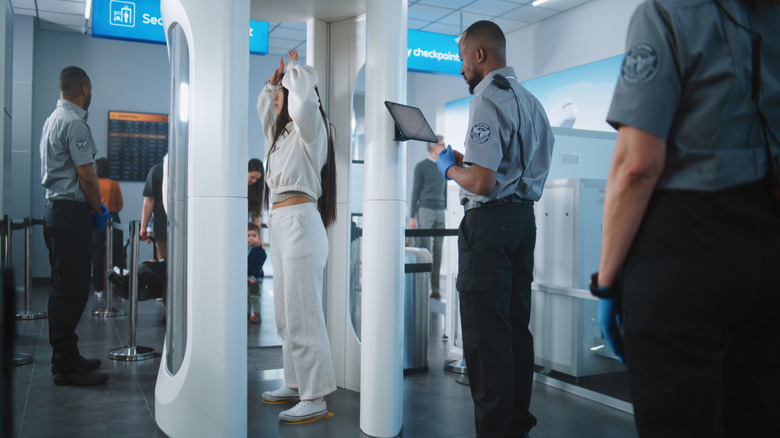
Perhaps the most time-consuming element of the airport security experience is the individual body scanner. A system that could produce the very same results for multiple people at once would be ideal. That is the concept behind HEXWAVE. Developed by Liberty Defense, the company describes it as "active 3D radar imaging and artificial intelligence (AI) to detect a range of threats, including both metallic and non-metallic weapons, in both indoor and outdoor environments."
It's a system that can be used in a variety of crowded places, such as sports stadiums, and could have just the same utility in airports too. It's able to differentiate between multiple people and form a comprehensive picture of each of them, using very weak radio waves to put together a 3D image of each person almost instantly.
The Massachusetts Institute of Technology reports that "TSA is now in the process of evaluating HEXWAVE as a potential replacement of metal detectors to screen PreCheck passengers," and in 2023, it was tested in TSA's PreCheck lanes. On top of that, an April 2026 deadline was announced for U.S. airports to comply with the TSA Mandate on Employee Screening, and some have elected to use HEXWAVE units to ensure compliance. They could be used more broadly across the nation's airports, possibly having a big impact.
TSA ConfirmID
Air travel can be incredibly stressful, and there's nothing worse on top of that than arriving at the airport and discovering that you don't have all the documentation you need. On February 1, 2026, a new initiative from the TSA came into effect. It's called TSA ConfirmID, and it just might save your trip.
This system can be used by those who are otherwise unable to provide a form of identification approved by the TSA, such as a U.S. passport (or one issued by another nation), REAL ID driver's license, or appropriate digital option such as Google ID pass. Travelers within the U.S. who don't have one of these, or left it behind en route to the airport, can instead pay a $45 fee to the TSA to apply to pass through security screening with the ConfirmID. This can be done on the program's website prior to arrival at the airport or once there, and involves completing a form to verify your identity.
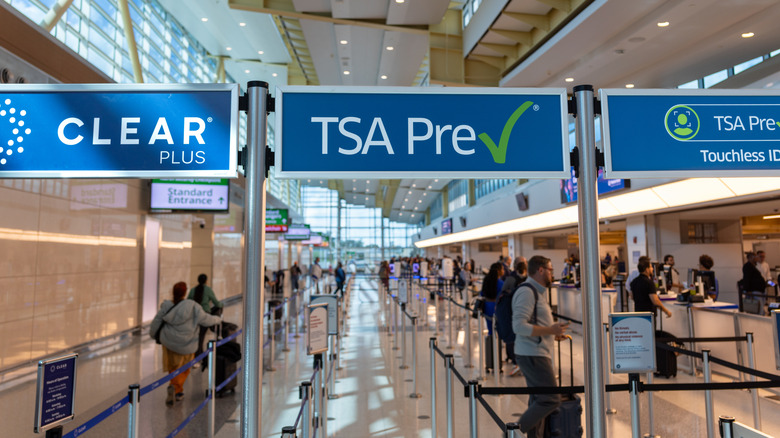
This part of the process yields a receipt to be provided to a TSA officer, who will then instigate the process to confirm the holder's identity using biometric data and facial recognition technology. These systems themselves have seen considerable development at the TSA. The new Touchless ID functionality for users of the TSA's expanding PreCheck system, for example, allows them to pass straight through security points using just facial recognition, though physical documents should still be carried.