

5 Android Phones That Are More Powerful Than The Google Pixel 10
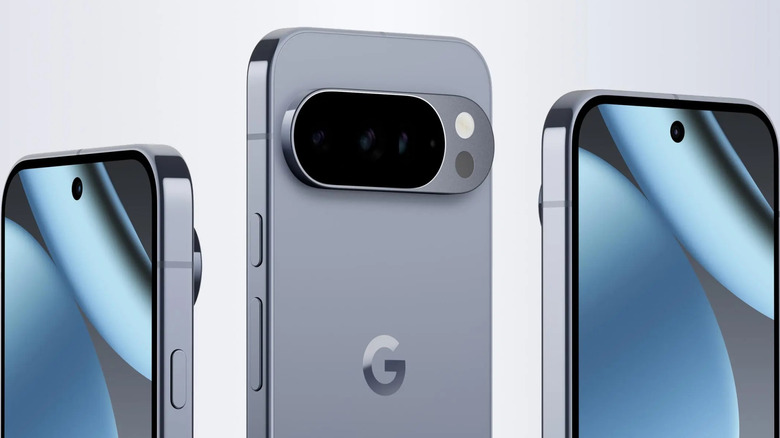
The Pixel 10 may be the flagship device Google uses to showcase Android to the world, but it's far from the most powerful smartphone on the market — even excluding Apple's beefiest iPhone 17 Pro Max. Google relies on Tensor, the company's own custom silicon, to power the Pixel. That allows the search giant to pack its phones with more AI processing, but the Tensor series has never stacked up all that well against the best chips from more established manufacturers like Qualcomm. Even at the time of its release in August of last year, it was getting lapped in performance by heavy hitters released even earlier in 2025.
With that in mind, it wasn't hard to round up a few of the Android phones that anyone shopping for the most powerful smartphone in early 2026 should consider before settling on the Pixel 10. This comparison looks at the standout specs for each phone rather than considering them holistically, and does not take price into account, but simply compares key performance-related specs.
Many consumers will, of course, find value in sacrificing certain specs for a lower price, even if it means a less powerful smartphone. But if power's what you're after, look no further. From some of the phones against which the Pixel 10 was primarily competing at launch to Chinese phones that are making it look downright outdated, and even one phone so powerful that it comes with the world's first liquid cooling solution in a mobile handset, there are plenty of powerful handsets to consider.
Samsung Galaxy S25
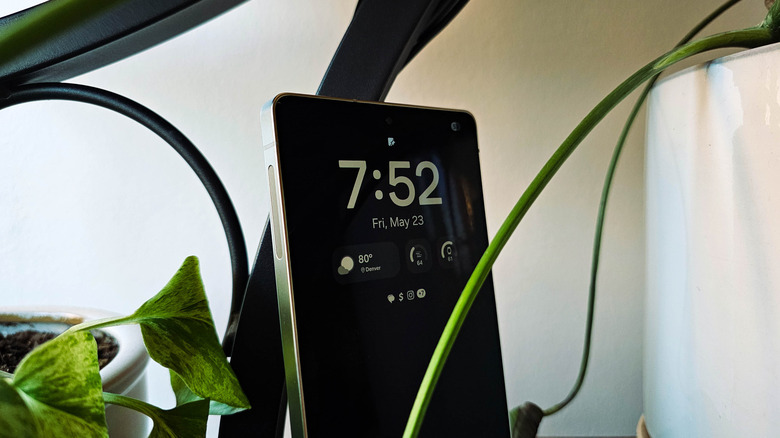
The Samsung Galaxy S25 series launched at the start of 2025, predating the Google Pixel 10 lineup by about six months. Nevertheless, it handily thumps Google's flagship in a head-to-head. The entire S25 lineup, from the base model all the way up to the premium Galaxy S25 Ultra, runs on the same chipset. That would be the Qualcomm Snapdragon 8 Elite, widely considered the most powerful smartphone processor of last year.
In testing from Android Central, the Snapdragon 8 Elite beat the brakes off the Pixel 10 in benchmarks across the board, with the sole exception of AI tests. That makes sense, since the Tensor G5 chip powering Google's flagship was designed to prioritize AI performance, which necessarily comes at the cost of other concerns like 3D graphical performance. With big upgrades to the TPU (Google's custom AI nodes, which are reportedly causing a small panic at Nvidia), the Pixel 10 is a go-to recommendation for those who want to run a lot of AI on their phone, but the Galaxy S25 is better for users who like to push their device with the latest games and productivity multitasking.
Both phones have the same 12 GB of RAM, which makes the processing performance delta the main difference between these two phones in terms of power. However, the Pixel 10 Pro does have 16 GB of RAM, whereas even the S25 Ultra remains frustratingly stuck at 12 GB. For users whose smartphone workflow relies heavily on RAM-hogging apps, this could be a crucial difference that tilts the balance in favor of the Pixel 10 Pro.
OnePlus 15
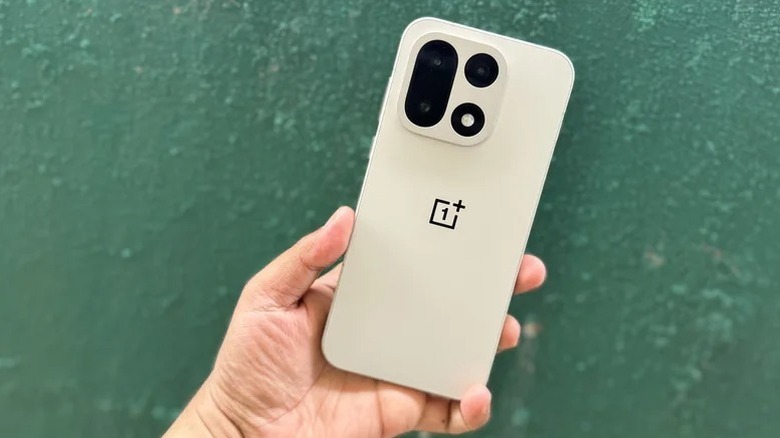
The rest of this list is basically cheating. That's because the phones we'll be discussing from here on out are powered by the Qualcomm Snapdragon 8 Gen 5, the follow-up to last year's excellent Snapdragon 8 Elite. As covered above, that processor was already giving the Pixel 10's Tensor G5 chip, designed by Google, a thrashing in benchmarks, and the 8 Gen 5 only widens that existing gap.
Introducing the OnePlus 15, the latest flagship from the Chinese enthusiast brand. Over the years, OnePlus gravitated from selling cheap phones that punched way above their weight class to now selling flagships that compete (on performance, not sales) with the likes of Samsung, Apple, and Xiaomi. The OnePlus 15 not only provides more processing power but can also be configured with up to 16 GB of RAM. While the Pixel 10 Pro matches that spec, the regular Pixel 10 has only 12 GB.
The OnePlus 15 is more powerful in other ways, too. It carries a whopping 7,300 mAh battery, made possible by silicon-carbon technology. Chinese phones have largely adopted this impressive new battery tech, which allows for higher energy density. The Pixel 10, meanwhile, retains a lithium-ion battery weighing in at 4,870 mAh, which is starting to feel a bit paltry in 2026. It also has an arguably more powerful screen, packing an AMOLED with HDR10+ support, a resolution of 2,772 by 1,272 px, and a refresh rate of 165 Hz. The Pixel is rocking an OLED with HDR support, a resolution of 2,424 by 1,080 px, and a refresh rate of 120 Hz. However, the Pixel does get brighter. Its display is rated for 3,000 nits, while the OnePlus 15 hits just 1,800 nits.
Xiaomi 17 Pro Max
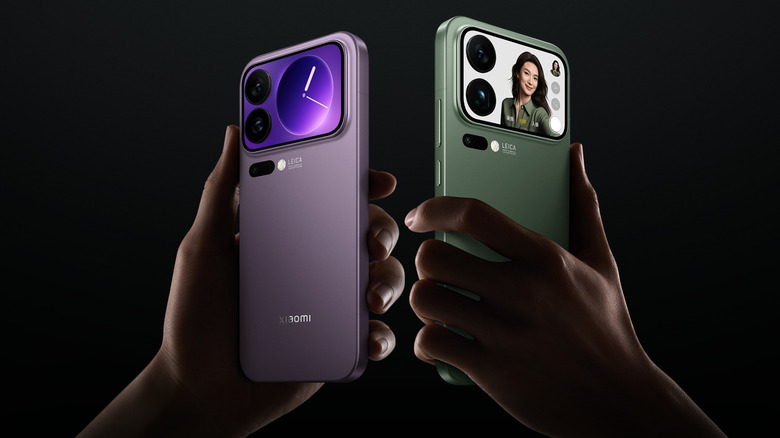
The Xiaomi 17 Pro Max made some waves in the smartphone enthusiast community when it launched toward the end of the third quarter of last year. The hubbub was for two reasons: first, this cheap Android phone looks near-identical to the latest iPhone 17, and second, it blew that phone out of the water in some crucial ways. It does the same to the Google Pixel 10.
The first thing you'll notice about the Xiaomi 17 Pro Max is that it looks like an iPhone 17 Pro Max. But then you'll notice the screen mounted onto its back camera array, and the way Xiaomi has subtly one-upped Apple in key specs. It, of course, packs the Qualcomm Snapdragon 8 Gen 5 chip that will be standard fare for 2026 Android flagship devices, and can be configured with up to 16 GB of RAM, muscling out the Google Pixel 10. Its triple-camera array, comprising three 50 megapixel sensors, also punches above the Pixel, which utilizes a 48 MP main, 13 MP ultra-wide, and 10.8 MP telephoto lenses. And Xiaomi has included a ludicrous 7,500 mAh, silicon-carbon battery, instantly dating the Pixel's 4,970 mAh lithium-ion cell.
We haven't even addressed Xiaomi's main gimmick, the 2.9-inch AMOLED bolted to the camera plateau around back. It can act as a camera viewfinder for high-resolution selfies, display ambient information, or show you a cute, digital pet. Whether you consider this "more powerful" than the Pixel's single display, or even think it's useful, it's certainly a capability that Google's device lacks.
Honor Magic8 Pro
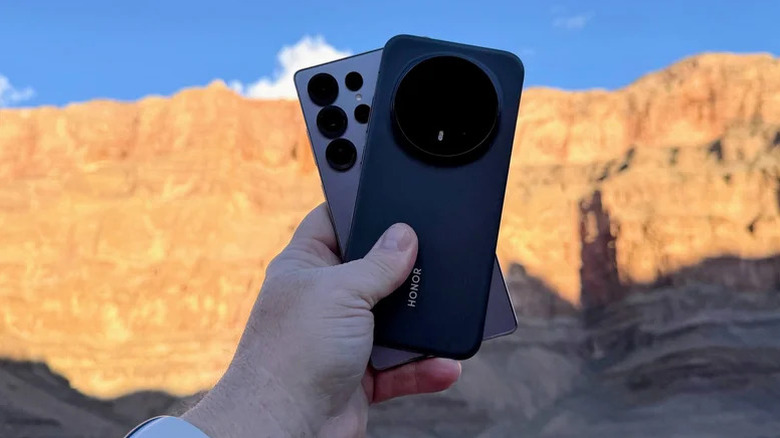
In international markets, which are far more saturated with smartphones than the U.S. tends to be, competition is fierce. Even when all the best phones are using the same chip — this year, the Qualcomm Snapdragon 8 Gen 5 — companies find other ways to stand out from the pack. The Honor Magic8 Pro is one such device. Released in October 2025, it can be configured with up to 16 GB of RAM. It easily and predictably beats the Pixel 10 Pro XL in performance benchmarks from Phone Arena, but battery and display specs are where it stakes its claim against other Chinese smartphone firms.
The Magic8 Pro is equipped with a 6.71-inch, LTPO OLED display with a 120 Hz refresh rate. It supports Dolby Vision and HDR Vivid, which are both welcome additions, but the peak brightness of 6,000 nits is the real hero spec. With twice the peak brightness of the Pixel 10, the Magic8 Pro can theoretically get bright enough to be somewhat painful to look at. Eye strain is tempered by a high pulse-width modulation dimming that reduces screen flicker, especially in low light.
While not the beefiest on this list, the Magic8 Pro also packs a 7,100 mAh battery for the global variant, which can be charged at up to a whopping 100 watts. In China, it's 7,200 mAh and 120 watts. In a smartphone landscape where the Pixel 10 is still charging at just 30 watts, that's a serious performance gap. MMtech Online looked at the Magic8 Pro as part of our CES 2026 Day 1 Roundup, and even got to put its 200 megapixel telephoto and 50 megapixel main lens to the test at the Grand Canyon, walking away with an eyebrow raised in respect.
RedMagic 11 Pro
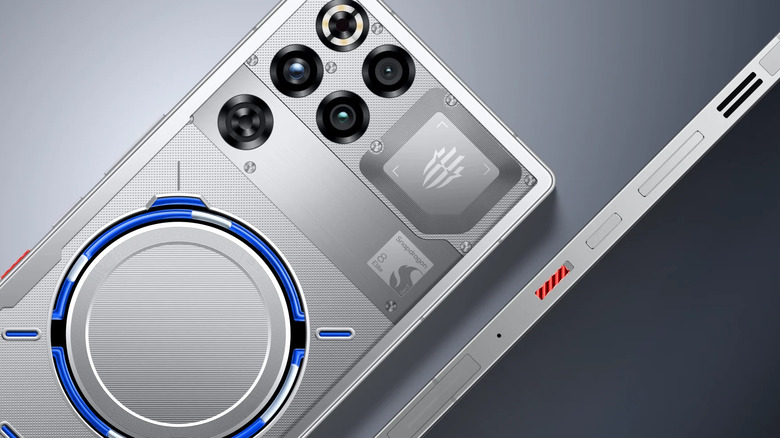
Lest you think other phones on this list have hit the ceiling for how much power can be crammed into a normal smartphone, have a gander at the RedMagic 11 Pro. A gaming-focused company owned by ZTE subsidiary Nubia, RedMagic has spent the past several years pumping out smartphones and tablets at suspiciously reasonable prices for devices packed with bleeding-edge specs. This year, the company has gone even further, bringing the world's first liquid-cooled smartphone. Given that the company often ekes more performance out of Qualcomm's latest chips by refusing to thermally throttle them, the jump to liquid cooling may be more than a gimmick.
Thanks to that cooling solution, which allows the Qualcomm Snapdragon 8 Gen 5 to run hotter than it safely can in other devices, the RedMagic 11 Pro was the fastest smartphone ever tested by Linus Tech Tips. It outpaced two other phones on this list — the OnePlus 15 and Samsung Galaxy S25 Ultra — by a healthy margin in single and multi-core tests. Through the transitive property, that also leaves the Pixel 10 and 10 Pro huffing its exhaust. In benchmarks conducted by GSMArena, it scored nearly four times higher than the Pixel 10 in some tests.
It's not just the processor that makes the 11 Pro so beastly. It can be configured with up to 24 GB of RAM — double that of the Pixel 10. Its 1,216 by 2,688 px AMOLED display can reach 144 Hz. It has a faster USB-C port and even a headphone jack. And, in keeping with other Chinese phones on this list, it carries a 7,500 mAh silicon-carbon battery. All of that comes for just shy of $1,000, whereas the Pixel 10's top configuration costs $900.
How these phones were chosen
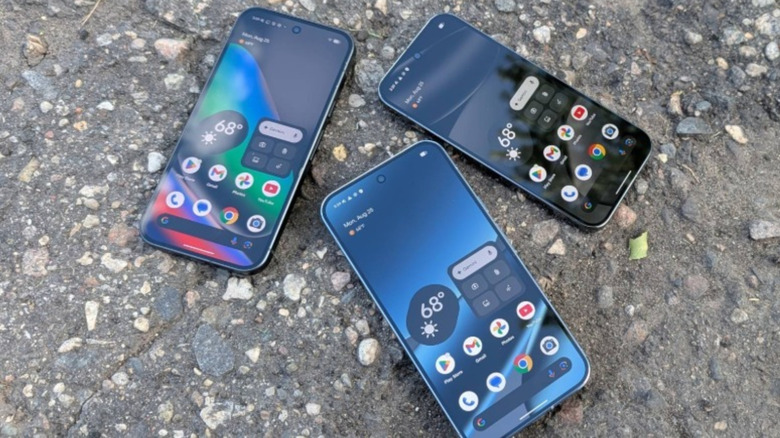
The phones on this list were selected based on their performance relative to that of the Google Pixel 10 series. Performance was primarily judged based on processor speed, but other factors, including battery, display, and camera specification, were also taken into account. These are not necessarily the most powerful Android devices overall, but are curated to represent a broad sample of smartphones from some of the most visible brands on the international market. Where multiple global variants of a device are available, this analysis was based on the model most readily available on the U.S. market.