

How B-2 Bomber Crews Sleep While Cruising 30,000 Feet In The Air
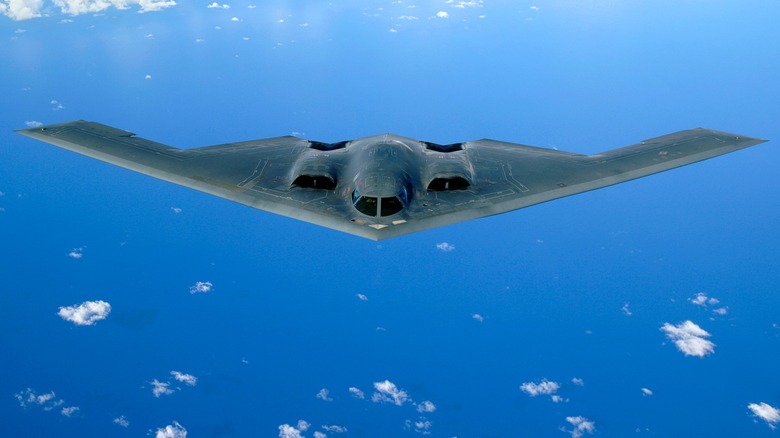
The Northrop-Grumman-built B-2 Spirit long-range strategic bomber is one of the most advanced military aircraft in the world, and it's a marvel of aeronautical engineering. The B-2's purpose is to infiltrate enemy airspace, deliver its payload, and return to base, which can be a significant distance from the target. The entirety of the B-2 fleet is operated by the U.S. Air Force's 509th Bomb Wing and the Missouri Air National Guard's 131st Bomb Wing out of Whiteman Air Force Base, Missouri.
B-2s have an unlimited range, thanks to aerial refueling, which means they can leave the air force base, fly to distant places like Iran, bomb their targets, and return — all in a single mission. While that's technologically incredible, the human achievement is nonetheless amazing because the B-2 requires two pilots to operate. They have to remain onboard throughout the mission, which often exceeds 20 to 30 hours of continuous flight operation. How then, does a B-2 bomber crew sleep?
The short answer is that they don't sleep in the same manner that they do on the ground. Instead, they plan ahead and take turns snagging short naps. This keeps them rested well enough to complete their mission without compromising the B-2's operability. Some might see this lack of sleeping options as a design flaw in the world's most expensive military aircraft. Ultimately, it's the discipline of the bomber's pilots and their training that makes it all possible, and preparation is the key to the B-2 crew's success.
Snagging some Zs at 30,000 feet
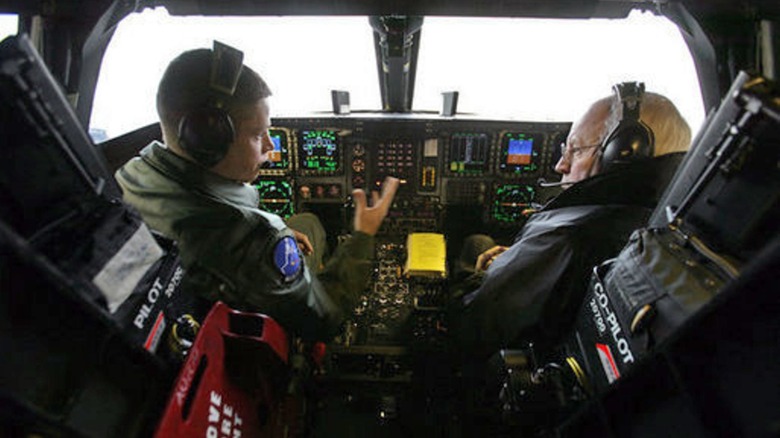
The B-2 is, by no means, a small aircraft, as it's capable of carrying a payload in excess of 40,000 lbs. Unfortunately for the crew, that means that the majority of its internal capacity is for bomb storage, limiting space within. The B-2's cockpit is somewhat cramped, but there is a 6-foot space just behind the seats where the pilots can lie down. Pilots are trained and supported by medical professionals who teach them techniques on how to handle the physical and psychological toll of the position.
Capt. Caleb James, a doctor with the 509th Medical Group, told Defense News, "There is a way you can shift that circadian rhythm back and forth by getting the appropriate amount of sleep, shifting your sleep schedule, and even modifying diet." For missions that exceed what most people can manage on a good day, doctors might prescribe meds "in the event that those members need that little bit of extra push to help them stay focused on the mission."
Any naps taken need to be scheduled around important tasks that occur on the mission. Lt. Col. Niki "Rogue" Polidor, a B-2 pilot and the 509th Bomber Wing's chief of safety, explained to the outlet that pilots nap for a couple of hours, but "it depends on our route of flight, where our refuelings are placed along that route, and where our weapons activity is." Once the crew lands, they conduct their debriefing and get some much-needed rest.