

Taking Your ATV On A Snowmobile Trail Could Be Breaking The Law
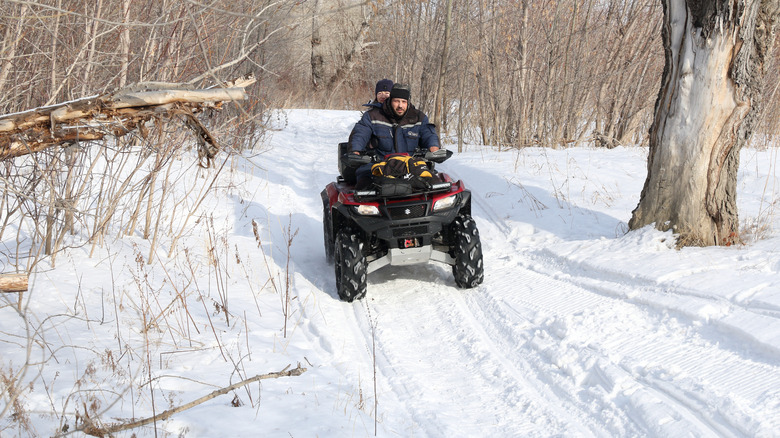
Joseph-Armand Bombardier is credited with creating the first mass-produced Ski-Doo snowmobile model in 1959. Though this model produced around just 10 horsepower, it would set the stage for some of today's highest horsepower snowmobiles from brands like Yamaha. All-terrain vehicle (ATV) development wasn't far behind when the first commercially available six-wheel amphibious ATV (the Jiger) was released in 1961. Not long after, John Plessinger created the three-wheeled Tricart in '67 for a college graduate project. He sold the idea to Sperry-Rand, which offered the model publicly in 1968. This was two years before Honda unveiled its three-wheeled ATC90 to the world and subsequently opened up the ATV market, paving the way for some of the coolest models available today.
The appeal of ATVs lies in their ability to rip through mud, sand, snow, and whatever else Mother Nature throws at them year-round. Meanwhile, snowmobiles have very specific traction requirements and can only be ridden during winter months on well-groomed, snow-packed trails. Because of this, states typically have different regulations for where you can and cannot ride your ATV or snowmobile. Further complicating matters is that certain trails located within national forests, state parks, or on public or private land all have different regulations.
For example, between December 1 and March 31, Indiana's Department of Natural Resources works with local snowmobile clubs and the Indiana Snowmobilers Association to operate over 200 miles of trails. Not only are all snowmobiles required to be registered to use these trails, but leaving them is considered trespassing. Furthermore, wheeled vehicles are strictly prohibited from using designated snowmobile trails at all times in the state.
Always know where to ride your chosen winter motor vehicle
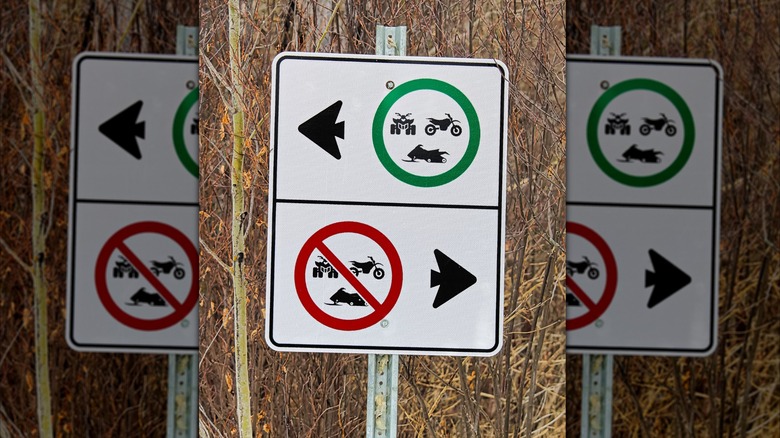
Michigan has over 6,000 miles of state-designated and operated trails, which are also only open between December 1 and March 31. ATVs aren't allowed on snowmobile trails on private or federal land, but other areas utilize a "shared-use" law that asks ATVers to respect groomed portions of trails by avoiding them in order to prevent damage. Meanwhile, in California's Sierra National Forest, there are over 180 miles of designated snowmobile routes open to both ATVs and Nordic skiers.
According to the American Council of Snowmobile Associations, Minnesota has 22,000 miles of groomed trails (after more than 10 inches of snow has fallen). ATVs are prohibited on most, but "shared-use" trails do exist where ATVs are allowed to run free — only when the air temperature is 30 degrees Fahrenheit or below. Meanwhile, Wisconsin has over 25,000 miles of groomed snowmobile trails. While it allows ATVs to use some snowmobile trails, not all of them are "open" and it is illegal to operate on certain ones.
Furthermore, states like Michigan, Minnesota, Vermont, and others require snowmobilers to purchase a trail permit. Other states, such as Idaho, Illinois, and Iowa, only require out-of-state snowmobilers to obtain a permit. Meanwhile, South Dakota, California, and Nevada don't require snowmobilers to get a trail permit at all. The point is, each state handles its trails in different ways, and regulations can differ from county to county. Since laws are so haphazard, it's always best to check local jurisdictional statutes and trail management organizations before hard charging into winter's wonderland.