

Is Starlink Mini Worth The Money? Here's What Actual Users Say
We may receive a commission on purchases made from links.
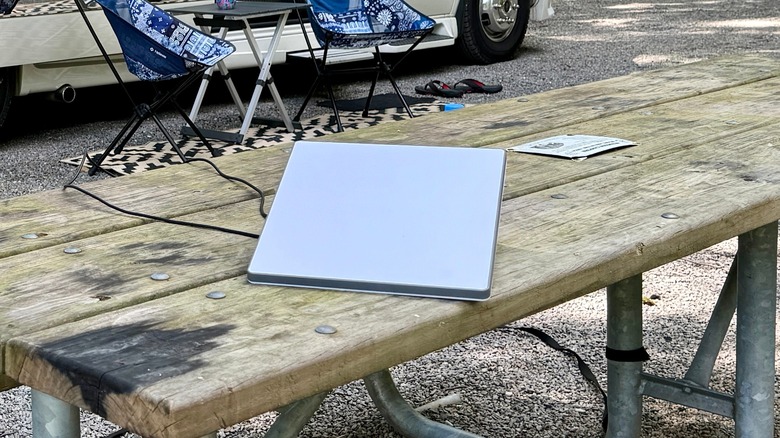
Starlink's satellite internet service keeps users connected whether they're at home or on the road, but accessing it will require a suitable Starlink device. The company offers two main variants: the standard Starlink and the Starlink Mini. There are a few key differences between them. While the Mini is a more portable, compact option, its performance is limited compared to its larger sibling. Various reviewers have put the Mini to the test across a variety of locations and have come away mostly impressed with its capabilities.
Joe Supan at CNET took the Starlink Mini on a hike in the Washington backcountry and used it to stream live sports in HD from a mountaintop, reporting average download and upload speeds of 127 Mbps and 17 Mbps, respectively. Supan's main complaint about the Mini was that its connection was easily interrupted by trees, with even light tree cover causing persistent issues.
Brian Westover of PCMag also had issues with the StarLink Mini's speed consistency, even though he kept the device in a single location without any trees nearby. His testing showed an average download speed of under 30 Mbps, with some days below 10 Mbps. His testing took place in rural Idaho. Over in Europe, The Verge's Thomas Ricker saw much higher average speeds both while testing the Mini at home and while on the road. With the Mini mounted on the roof of his van, he averaged 154.8 Mbps. That speed was comparable to the standard Starlink he had installed at home.
The Starlink Mini offers easy setup and impressive versatility
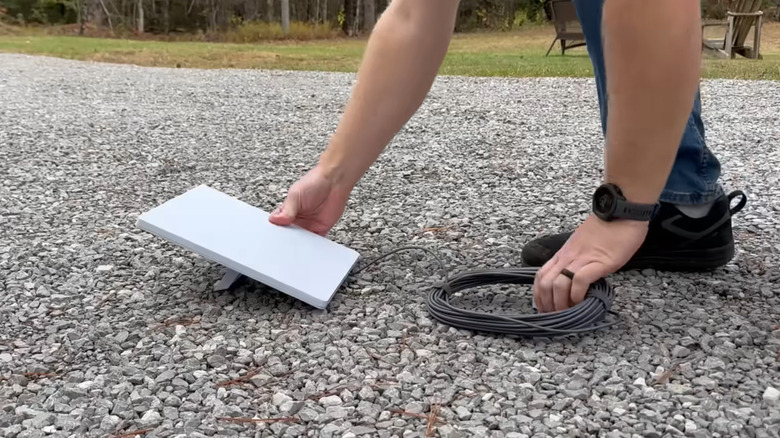
While the Starlink Mini's reported speeds can vary considerably by location and surrounding conditions, one thing that doesn't vary is how easy it is to set up. A review by Snowstead on YouTube highlighted the simplicity of the setup process: they plugged the device into a power source, waited around a minute for it to appear as an available router, then opened the Starlink app to finish the setup process. The whole setup took only a few minutes, although other reviewers report that it can take slightly longer — for example, CNET reported that Starlink Mini took around 10 minutes to find an initial connection while up in the mountains.
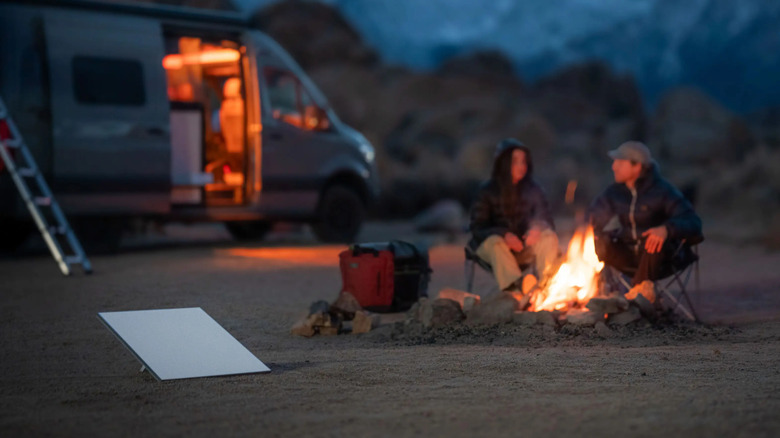
The Mini should work in a huge variety of settings, too, and be useful if you're in an RV or on a camping trip. Outdoor Auto points out that it's also suitable for many boaters. Starlink's standard Roam plan coverage includes coastal regions, defined as up to 12 nautical miles from the coastline. Open-ocean coverage is also optionally available. As standard, Starlink Mini's Roam plans cover in-motion use, no matter what kind of vehicle you're travelling in.
If you're planning to cross international borders, Starlink Mini's Roam plan lets you leave your home country for up to two months at a time. If you're still away from home after that point, you might need to subscribe to your plan in the country you're temporarily residing in, and that might change the price you pay.
Powering the Starlink Mini adds extra costs
Starlink's pricing for both its data plans and for the Starlink Mini device itself can change over time. At the time of writing, the Starlink Mini is available at Best Buy for a retail price of $499.99 (currently available at a discounted price of $229.99), but it's also worth checking its price on Starlink's website, as significant discounts on the device are sometimes available from either retailer.
The 50GB Roam plan costs $50 per month, while an unlimited data plan costs $165 per month. Users on the 50GB plan also have the option to purchase additional data in GB increments. Both plans include a "standby mode" that temporarily pauses them when you're not using them, which is particularly useful if you travel infrequently.
However, buying the device and a plan is only part of the total cost. You'll also need to work out how to power your Starlink Mini while you're on trips. Depending on your situation and setup, a suitable power source could be a power bank, your car's 12V socket, or even potentially solar panels. YouTuber Matt Zefi reported running his Starlink Mini entirely on solar power for several days on a trip, though the viability will depend on your solar panel output. If you're camping on a short trip, you could potentially rely on battery power, since Starlink's user manual notes that it draws an average of 25-40W while in use.
Assuming the high costs and performance limitations don't put you off, there's a lot to like about the Starlink Mini. If you're looking for a reliable way to stay connected while you're off-grid, it's a unique solution that's both easy to use and impressively capable.
How we gathered these user reviews

To ensure that the user feedback we gathered represented a broad overview of the Starlink Mini's capabilities and drawbacks, we searched for in-depth reviews from trusted publications and on YouTube. We only included reviews that were produced as a result of extensive real-world testing. Where relevant, we also drew information from Starlink's website, terms of service, and user manuals.