

A Huge Lithium Deposit In Canada May Have Just Been Found Thanks To AI Satellites
Lithium, a soft white metal that is often referred to as white gold in the context of energy transition, is a highly prized item. After all, lithium is the core component of batteries that power everything from electric cars and power storage kits to smartphones and toys. Just like silicon and the sophisticated machines that turn it into semiconductor chips, the U.S. is racing against China to secure its lithium supply for making EV batteries. But the U.S. stares at a shortage, Canada may have just struck gold. Fleet Space claims to have discovered a massive lithium deposit in Canada's Quebec region using AI and satellite observation.
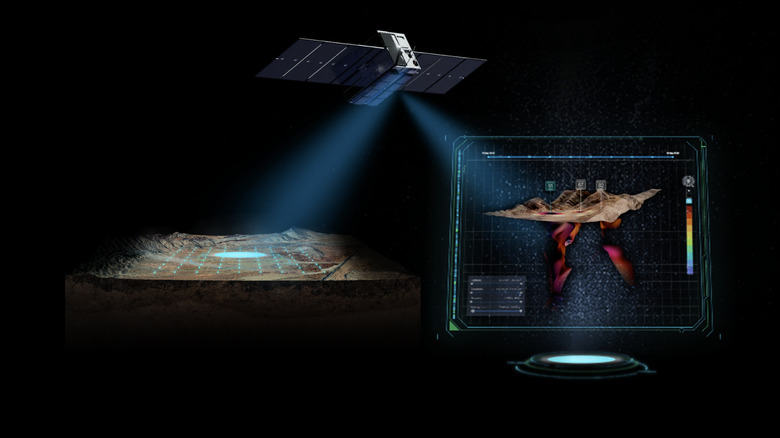
As part of the Cisco Lithium Project, the company zeroed in on an area covering over 41,000 hectares that is now an exploration target for mining up to 329 million tonnes of lithium mineral. For the lithium deposit discovery in Canada, the company relied on its Exosphere satellite platform, which is claimed to offer "multiphysics-driven understanding of complex geological systems." In simpler terms, it's a geophysical sensing system that performs multi-layer analysis of the surface.
Fleet Space operates a constellation of nano-satellites that rely on AI processing to deliver insights about sub-surface geology. The satellite system can perform 3D subsurface image capture at a depth of up to 7 kilometers. Fleet says its ANT+HVSR sensing is up to ten times more sensitive than the industry standard. The platform also deploys an MT system that can perform magnetic imaging at a depth of several kilometers. The overarching idea is to combine seismic, magnetic, electrical, geological, and gravitational data using on-ground sensors, and then relay it all to satellites for modeling work. It's a multi-layered analysis, but a crucial piece of the puzzle is the usage of predictive AI in the Exosphere satellite system.
How does AI enable lithium discovery?
The world's Lithium reserves are spread out rather unevenly. Together, Bolivia, Chile, and Argentina account for more than half of the reserves, while China remains the dominant hub for processing the metal. But recent discoveries threaten to dramatically change the landscape. In July, China reported the discovery of a large lithium deposit estimated to hold nearly 500 million tons of the precious ore. The discovery of another site of a similar magnitude in China could prove to be pivotal for Western countries, thanks to AI. But how does AI fit into the equation?
Fleet Space says it relies on AI to speed up exploration and enhance the accuracy by spotting where valuable minerals are most likely to be underground. The ExoSphere system combines satellite and sensor data to predict what types of rocks and minerals are below the surface, helping teams decide exactly where to explore next. The ultimate goal is to select drill targets with the highest resource potential, an approach that saves valuable time and cost that would otherwise be incurred from expanded drilling operations.
Just like AI models used in the field of medical science, Fleet Space's AI has been trained on past drilling datasets in the public domain and hundreds of its own surveys to build geology models and offer valuable insights. But finding a lithium reserve does not equal extraction success. According to a paper published by the Department of Earth Sciences at Uppsala University, "the success rate of exploration is less than 1 mine from 1000 exploration projects, and projects can take decades to convert from discovery to producing mine." Satellite AI tech, the kind Fleet Space offers, is helping speed up the pace of exploration, but not all potential sites are the metaphorical gold mine.