

5 Of The Strangest Patents Owned By Nintendo
Nintendo is a brand that has become synonymous with video games, but that wasn't always the case. Over more than a century, the company has shown a willingness to adapt and experiment that persists even today. Nintendo's history is fascinating; when it first launched in 1889, it was primarily a maker of playing cards.
As time went on, Nintendo tried its hand at making instant rice and various toys, as well as operating hotels and a taxi service. The company was nearly a century old by the time the Nintendo Entertainment System (NES) made its way into living rooms all over the world. Today, Nintendo is a large company with a suite of successful video game consoles and handhelds including the NES, Super Nintendo, Nintendo 64, the Wii, the Switch, Game Boys of various designs, the 3DS, and more — including some rare Nintendo consoles as well.
For every device that hits store shelves, Nintendo holds countless patents for iterations, adaptations, and gadgets that never went into production. Many are what you'd expect — methods for storing, processing, and playing video games, video game cartridges, charging stands, and the like. Then there are the patents that step off the beaten path and reveal Nintendo's willingness to get weird.
Sleep tracker and projector
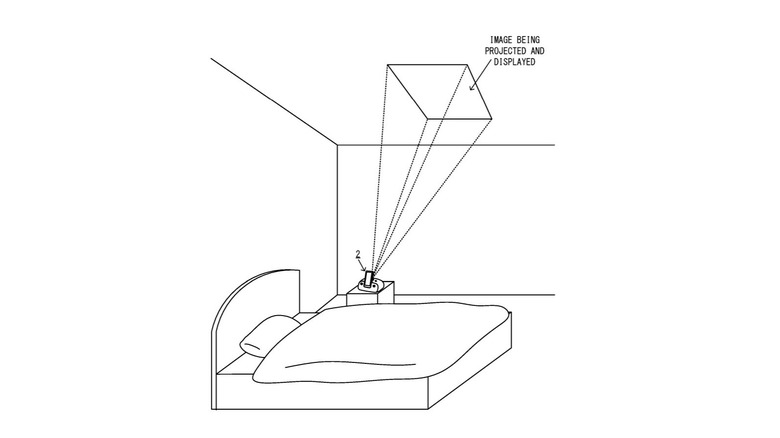
While most of Nintendo's patents appear to be at least tangentially related to video games, this one is for something that might have given many of the best sleep tracking devices available a run for their money. It features a design similar to an alarm clock, with what looks like a mounted smartphone or tablet, and a projector that displays information on the ceiling. The patent (10987042) describes it as a display system which includes a sensor and a projector.
The sensor is designed to pick up user information like your pulse to monitor your sleep, then project relevant information on the ceiling when you wake up. According to the patent, the device would go through a regular sequence, sensing sleep data, calculating, then determining if you're awake. If not, it keeps sensing and calculating. Upon you waking up, it would crunch the numbers and present you with a readout.
It could also provide environmental information and activities to help you meet your health goals. The patent even suggests the device could offer you points for meeting those goals, essentially gamifying your wellbeing. It would have also allowed you to set up multiple users and receive data on others in your home, presumably so parents could keep an eye on their kids' sleep health.
Hinged Switch controller
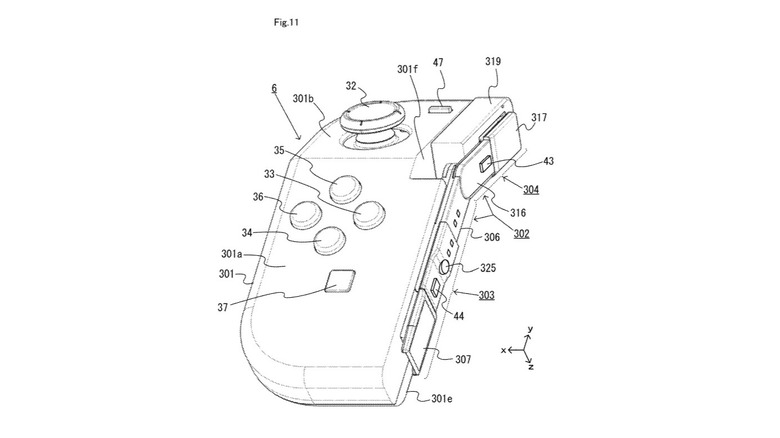
Innovation in video games isn't just about creating more powerful platforms and more immersive games; it's also about changing the way we interface with those games. With that in mind, Nintendo filed a patent (10632368) describing a version of the Nintendo Switch Joy-Con connected together via a pivot. Some of the company's ideas are truly unhinged. This one, by contrast, is hinged.
In terms of button layout, it's basically identical to its less mobile counterparts. The hinged design was presumably intended to make the controller more comfortable, or at least more customizable. The patent notes that the original Joy-Con design was limited by the fixed and linear nature of the rails on the sides of the Switch console. The patented hinged controller represents a middle ground, allowing the controllers to mount to the console without losing the intended mobility.
Whether the hinged controller would have actually been an improvement or not, we'll never know. Instead, the patent remains an exercise in creative design, showcasing how controllers could be more flexible and imaginative. Until then, you can check out these Nintendo Switch controller alternatives designed to combat "Joy-Con drift", a common problem with the thumb sticks of the original Switch's controllers.
Electronic trading cards
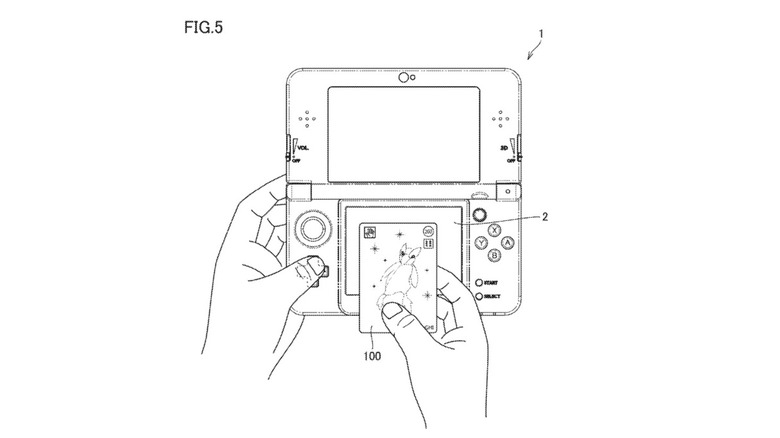
Hailing back to the company's origin as a producer of playing and trading cards, Nintendo holds a patent for a modern electronic trading card. According to the patent (10279273), these cards would have featured characters and housed an electronic component capable of storing, and wirelessly transmitting, information.
The characters presented in the patent are original creations, so it's unclear if the cards would have been connected to any existing IP. Pokémon comes to mind, of course, but it could as easily have been characters from any of Nintendo's universe of games, or entirely new characters we haven't yet met.
These trading cards would have used the same sort of contactless communication found in banking or public transit cards. The patent includes a drawing of a card interacting with a Nintendo 3DS, suggesting the cards could interact with games, similar to Nintendo's Amiibo accessories for the Switch. The patent notes that while conventional trading cards rely on their aesthetics for their value, these would have offered even more, with non-visible content in the digital layer.
Horseback riding device
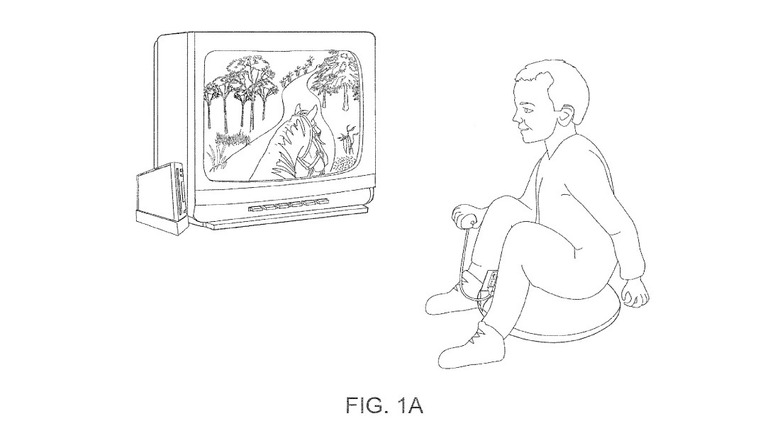
Nintendo is no stranger to bizarre peripherals. Way back in the NES era, the company offered one for shooting digital ducks (the mechanics behind the "Duck Hunt" gun were quite ingenious) and a floor pad to transform running and jumping into button inputs. One weird peripheral we never got was a horseback riding simulator for the Nintendo Wii.
The patent (8277327) describes an inflatable air cushion paired with a Wii remote to capture the motion of the cushion and player to then use that data to create a real-time horseback riding simulation. In addition to recording your motion, it would have been programmed with some logic. For instance, if the controller detected a sudden pulling back motion, that would have translated to a stop command. Gentle motion to the right or left would have made you turn. And the device was designed to detect side-to-side balance along with your movements forward and backward.
You could have even used the Wii remote to simulate whipping motions or toss a lasso. Importantly, the patent notes it could simulate horses and/or other animals. You can peruse Nintendo's catalogue of potentially rideable characters to imagine what that might mean; a "Super Mario" game featuring a rideable Yoshi could have been one possibility, though.
Game Boy phone case
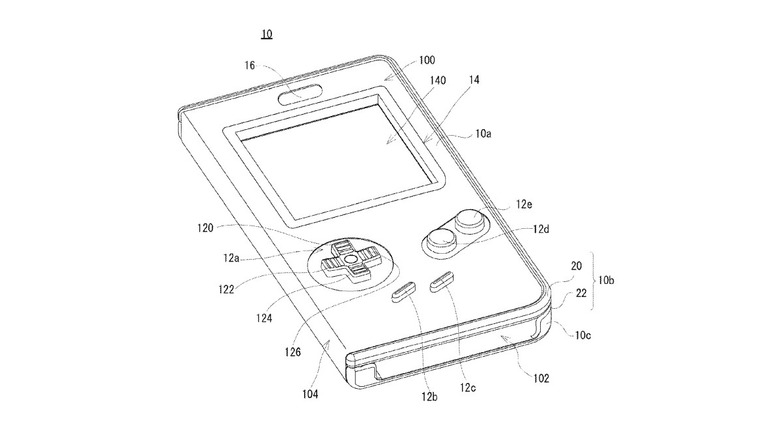
Nintendo is the undisputed champion of the handheld gaming space. While there have been and still are alternatives, if you're looking for a mobile gaming experience, Nintendo has long dominated the market. The largest actual competitor might be a device we don't think of as a gaming console, the smartphone.
Once upon a time, Nintendo was toying with the idea of subsuming the smartphone into its own domain with a case that would turn your phone into a functioning Game Boy. More accurately, it describes a case which would be attachable to any electronics with a touch screen, but a smartphone seems the obvious choice.
The patent (20180275769) describes the method by which the case transfers button inputs from the D-pad, Start, Select, A, and B buttons into touchscreen inputs for the smartphone inside. Because the case would have covered the front and back of your phone, you'd need to open it to use your phone for anything but playing games.